

Knowing the Difference Between How Your Pool Looks and How the Water Actually Feels
I’ve been working with pools in Collin County for a long time now. My company, Hamilton Pools, handles pool maintenance and cleaning all over places like Allen, McKinney, and Frisco. You see all kinds of pools out here. But one thing I’ve learned, over and over, is that how a pool looks isn’t always how it is. You can look at a pool and it might be crystal clear, sparkling under the Texas sun, and you’d think it was perfect. But then you get in, and something just feels off. Or worse, you find out the water chemistry is completely out of whack.
We actually experienced this firsthand a couple of years ago. Our family had lost a really special dog, and we were heartbroken. We decided to get away for a weekend, so we rented a nice house in Dallas that had a pool. We brought our Doberman, invited some friends and their kids, and were ready to just relax and swim. The pool looked fantastic – clean and blue. So, everyone jumped in. At one point, our dog took a quick lick of the water, immediately spit it out, and started shaking his head like he’d tasted something awful. That got my attention. I happened to have my pool test kit with me, so I pulled it out and tested the water. What I found was some of the worst chemistry I’d ever seen. We got everyone out of the pool right away. The water was so bad, we actually left early the next morning, cutting our weekend short. I called the homeowner and let him know what we found, and he was really thankful we told him so he could fix it. That whole experience just confirmed what I already knew: a pool can look perfectly clean, but still have seriously unbalanced water. There’s a lot more to a healthy, properly maintained pool than just what you can see with your eyes.
Why Looks Can Be Deceiving
It’s easy to assume that if you can see the bottom of your pool and the water isn’t cloudy or green, everything’s good. But clarity doesn’t tell you the whole story about what’s going on in that water. You might have enough chlorine to kill algae, which keeps the water from turning green, but other chemicals could be totally out of balance.
Think of it like this: you can have a clean drinking glass, but if you fill it with water that has too much salt or not enough of something else, it’s not going to taste right, and it might not be good for you. Pool water is similar. It needs to be balanced across several different measures, not just one.
The Hidden Culprits of Unbalanced Water
When we talk about water chemistry, we’re looking at a few main things. The pH level, the alkalinity, calcium hardness, and of course, your sanitizer level, usually chlorine. Here in Collin County, with our hard water from the North Texas Municipal Water District (NTMWD), calcium is often a big one we battle.
If these levels are off, even if the water looks clear, you’re going to feel it. And your pool equipment will feel it too.
Just because your pool looks clear doesn’t mean it’s safe or comfortable to swim in. Good chemistry is invisible, but you can feel it.
How Unbalanced Water Feels on Your Skin and Hair
When pool water isn’t balanced, you’ll notice it fast. This goes past mild discomfort. It can actually affect your body.
Dry, Itchy Skin and Irritated Eyes
Have you ever gotten out of a pool and felt really dry and itchy? Or your eyes were red and burning for hours? A lot of people blame chlorine for this, and sometimes that’s part of it, especially if the chlorine level is too high. But often, it’s actually the pH level that’s the problem. Our skin and eyes have a natural pH level, and when the pool water’s pH is too far off from that, it causes irritation.
If the pH is too low (acidic), it strips your skin’s natural oils, leaving it dry and itchy. It also makes chlorine much more aggressive, leading to more irritation. If the pH is too high (basic), it can also dry out your skin and make your eyes feel gritty. It also makes chlorine less effective. Neither extreme is good.
Brittle Hair and Faded Swimsuits
Your skin isn’t the only thing that pays for it. Unbalanced water can wreak havoc on your hair, too. Hair can become brittle, dry, and even take on a greenish tint if you have high copper levels mixed with high chlorine and high pH. This is especially true for blonde hair.
Your swimsuits can suffer too. The dyes in fabric can fade faster, and the elastic can break down quicker when exposed to water that’s either too acidic or too basic, or if chlorine levels are consistently too high.
The Silent Damage to Your Pool Equipment
Swimmers aren’t the only ones who suffer for it. Your pool itself takes a beating. This is where ignoring the problem can get really expensive.
Corrosion and Scale Buildup
If your water is too acidic, it will slowly corrode everything metal in your pool system. We’re talking about the heater elements, pump seals, even the screws in your skimmer baskets. I’ve seen Hayward heaters that are only a few years old get totally eaten away because the homeowner wasn’t keeping up with their pH and alkalinity. Acidic water also eats away at plaster finishes, shortening the life of your pool surface.
On the flip side, if your water is too hard or has high pH and alkalinity, you’ll start seeing calcium scale. This is that rough, white buildup that shows up on your pool tile, inside your filter, and in your plumbing. We see a lot of this in North Texas because of our naturally hard water. You can read more about what causes white buildup on pool tile on our blog. This scale can clog up your filter grids, reduce water flow through your plumbing, and make your heater work harder, eventually leading to breakdowns. I’ve had to acid wash plenty of pools in Plano and McKinney where the scale buildup was so bad it was damaging the plaster.
Problems with Sanitization
Even your sanitizer, like chlorine, struggles with unbalanced water. If the pH is too high, chlorine becomes much less effective at killing bacteria and algae. You could have a good chlorine level reading, but it’s just not doing its job. This means you might need to use more chlorine to keep the pool clean, which costs you more money and can still lead to skin and eye irritation. Maintaining proper chemistry ensures your pool stays clean and you avoid swimming-related illnesses.
Assuming cloudy water means you only need more chlorine. Often, the real issue is unbalanced pH and alkalinity, which makes chlorine ineffective.
Testing Your Water: The Real Story
So how do you actually know what’s going on in your pool water? You test it. Two main ways to do that, and they are not close to equal.
DIY Test Strips vs. Professional Kits
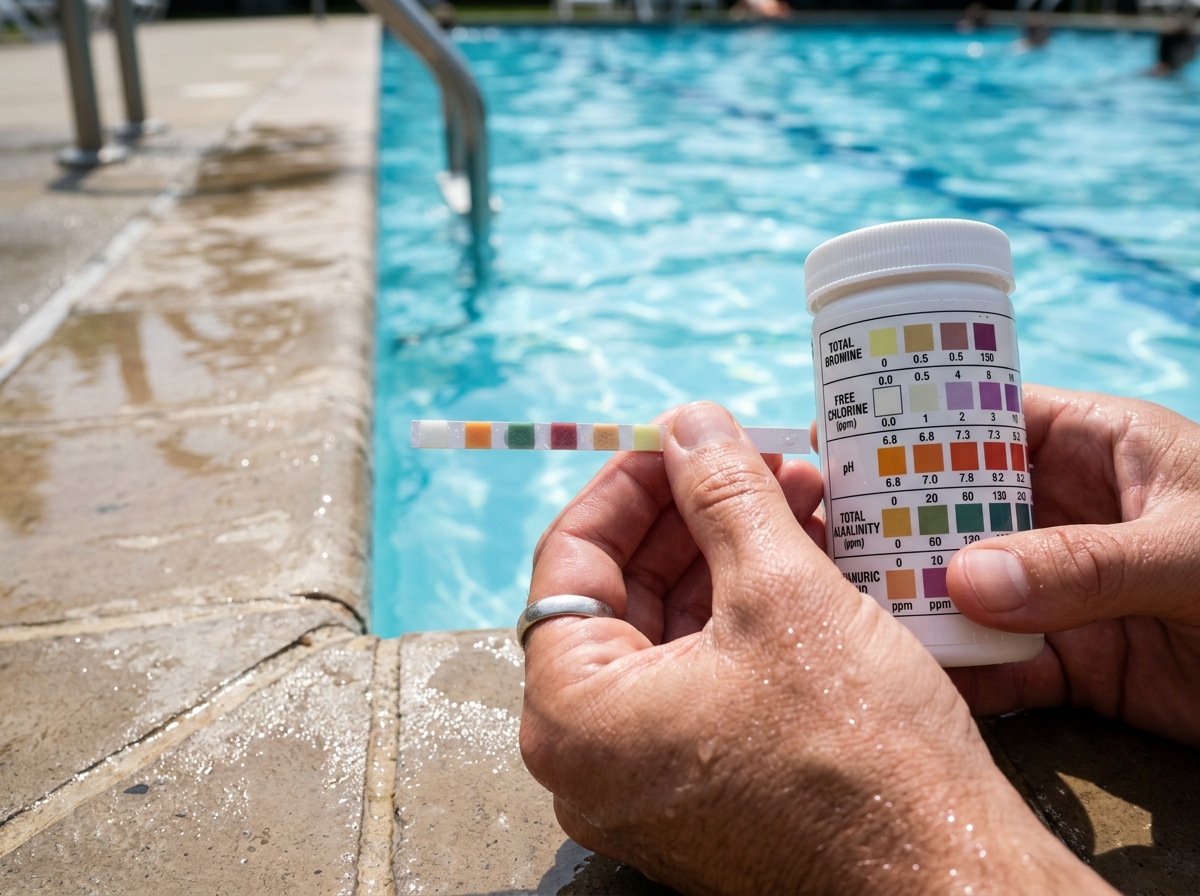
Most pool owners start with test strips. You dip a strip in the water, wait a few seconds, and then compare the colors on the strip to a chart on the bottle. They’re quick and easy, but frankly, they aren’t always the most accurate. The colors can be hard to match perfectly, and things like bright sunlight can affect how you read them. They give you a general idea, but for precise readings, they often fall short.
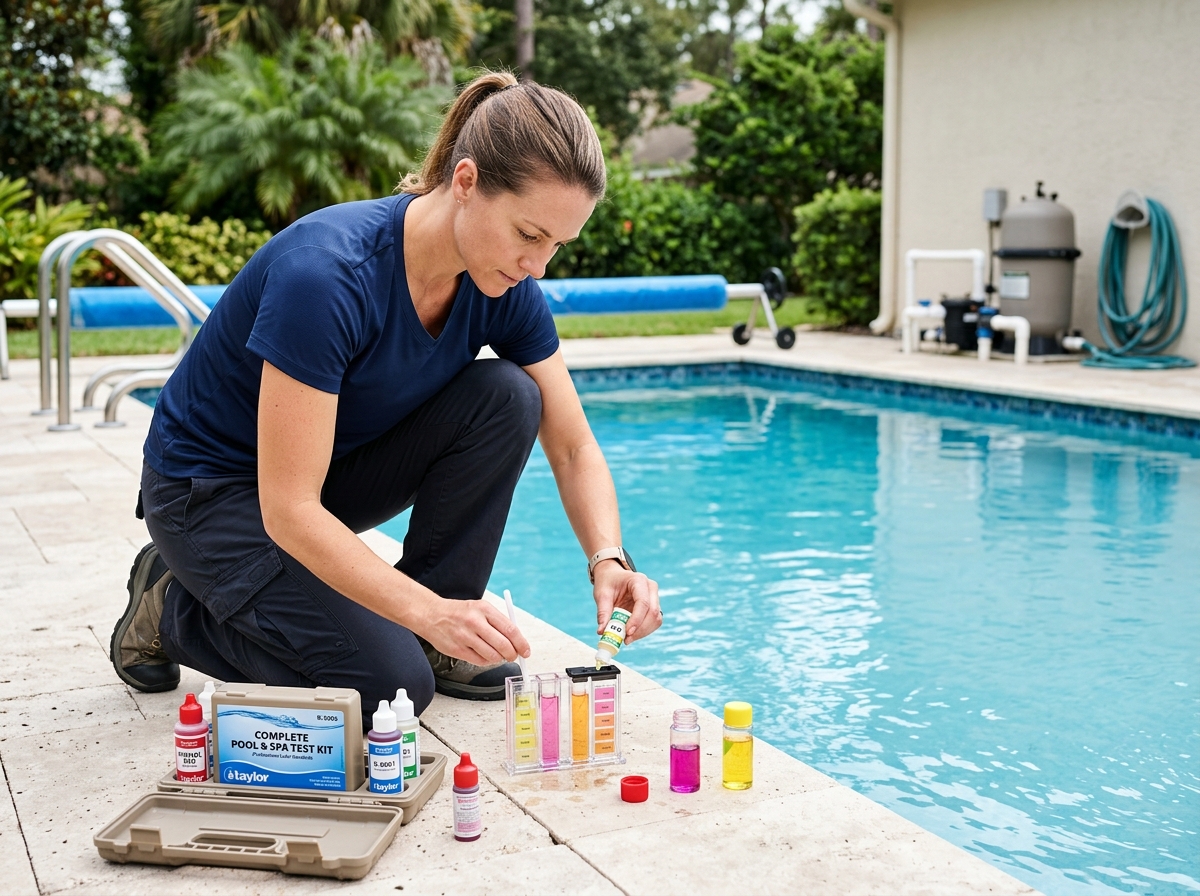
If you’re serious about your pool’s chemistry, you need a liquid test kit. Kits like the ones from Taylor Technologies give you much more accurate readings for pH, chlorine, alkalinity, and calcium hardness. You add drops of reagents to water samples, and the color changes are much clearer and easier to read precisely. This is what we use at Hamilton Pools when we’re doing regular pool maintenance for our clients in Prosper and Murphy. The difference in accuracy is huge.
| Feature | DIY Test Strips | Professional Liquid Test Kit |
|---|---|---|
| Cost | Low | Higher initial cost |
| Accuracy | Basic, can be hard to read | High, precise readings |
| Ease of Use | Very easy, quick dip | Requires a few more steps and understanding |
| What it tests | Chlorine, pH, Alkalinity, sometimes Hardness | Chlorine, pH, Alkalinity, Hardness, Cyanuric Acid, etc. |
| Best for | Quick checks, very basic maintenance | Detailed water balancing, problem-solving |
When to Test and What to Look For
I recommend testing your water at least twice a week during the swimming season, and definitely after any big rainstorms. Our spring storms here in Texas can dump a lot of water into a pool, which dilutes your chemicals and usually throws off your pH.
Here are the target ranges you’re aiming for:
- Free Chlorine: 1-3 parts per million (ppm). This is the active chlorine that’s sanitizing your pool.
- pH: 7.4-7.6. This is super important for swimmer comfort and equipment protection.
- Total Alkalinity: 80-120 ppm. This acts as a buffer for your pH, keeping it from bouncing all over the place.
- Calcium Hardness: 200-400 ppm. Important for gunite pools to prevent etching of the plaster. With NTMWD water, we often have to manage high calcium.
- Cyanuric Acid (Stabilizer): 30-50 ppm. This protects your chlorine from burning off too quickly in the hot Texas sun.
If your readings are outside these ranges, you’ll need to adjust them. This often involves adding chemicals like muriatic acid to lower pH, or soda ash to raise it. For calcium hardness, it’s harder to lower without partially draining and refilling, which is why we monitor it closely.
When to Call the Pros
Maintaining pool chemistry can feel like a science project sometimes, and it’s not for everyone. If you’re struggling to keep your water balanced, or if you’re just short on time, that’s where we come in.
For a lot of homeowners in Wylie and North Richardson, a weekly maintenance visit from Hamilton Pools takes all the guesswork out of it. We come out, test the water with our professional kits, and make all the necessary adjustments. This isn’t just about adding chlorine; it’s about making sure every chemical is where it needs to be so your pool water feels as good as it looks.
Sometimes, a pool has really gotten away from the homeowner. Maybe they’ve had a problem with high calcium for a long time, and now they have serious scale buildup on their tile and in their equipment. Or the water is green, and they can’t clear it up. These are times when it’s best to bring in someone with experience. We’ve got the tools and the know-how to get things back on track. We also deal with salt cell systems, which are a different way to sanitize but still need careful chemical balance.
Chlorine isn’t the only piece of the puzzle, either. Every number on that test kit has to be in range at the same time, not just one or two of them. That’s the real difference between a pool that just looks clean and one that actually is clean, safe, and comfortable to swim in.
—